10 Proven AI SEO Strategies to Increase Organic Traffic in 2026
Search engine optimization is evolving faster than ever. While traditional SEO remains the foundation of online visibility, artificial intelligence is transforming how people search for information and how businesses earn organic traffic.
Today, users aren’t limited to typing short keywords into Google. They ask complete questions to AI-powered platforms like ChatGPT, Google Gemini, Perplexity AI, Claude, and Microsoft Copilot. These platforms analyze multiple trusted sources and generate direct answers, often reducing the need to browse through several websites.
For businesses, this shift presents both a challenge and an opportunity.
The challenge is that ranking on Google alone is no longer enough. The opportunity is that companies investing in AI SEO can expand their visibility across both traditional search engines and AI-powered search experiences.
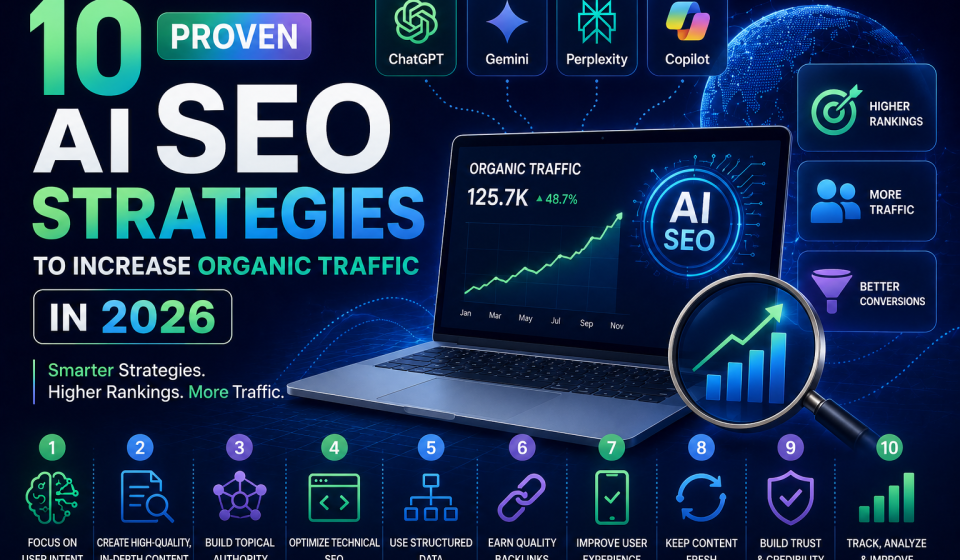
In this guide, we’ll explore ten proven AI SEO strategies that can help improve your website’s visibility, strengthen your authority, and attract more qualified organic traffic in 2026.
1. Build Topical Authority Instead of Chasing Keywords
Many businesses still create content around isolated keywords. While keyword research remains valuable, AI-powered search systems increasingly reward websites that demonstrate expertise across an entire subject.
Rather than publishing one article about AI SEO, create a comprehensive content hub that covers related topics such as:
- AEO (Answer Engine Optimization)
- GEO (Generative Engine Optimization)
- LLM SEO
- Schema Markup
- Voice Search SEO
- Technical SEO
- AI Content Optimization
- AI Overviews
When these articles are internally linked, they signal that your website is a reliable resource on the topic.
2. Write for Real Questions, Not Just Search Terms
AI assistants understand natural language, so your content should reflect how people actually ask questions.
Instead of focusing only on a keyword like AI SEO, answer questions such as:
- What is AI SEO?
- How does AI SEO work?
- Is AI SEO different from traditional SEO?
- Why does AI SEO matter in 2026?
Providing clear, direct answers improves the user experience and makes your content easier for AI systems to understand.
3. Publish Original, Experience-Based Content
AI-generated summaries often prioritize trustworthy sources.
One of the best ways to build trust is by sharing your own experience.
Include:
- Client success stories
- Case studies
- Campaign results
- Lessons learned
- Industry observations
- Practical examples
Original insights help your content stand out from generic articles that simply repeat existing information.
4. Strengthen Your Technical SEO Foundation
Even exceptional content can struggle if your website has technical issues.
Review your site regularly to ensure it:
- Loads quickly
- Works well on mobile devices
- Uses HTTPS
- Has clean URLs
- Avoids broken links
- Includes optimized metadata
- Is easy for search engines to crawl
A technically healthy website provides a better experience for both users and search engines.
5. Use Structured Data to Improve Context
Structured data helps search engines understand what your content represents.
Depending on the page, consider implementing schema for:
- Articles
- FAQs
- Organizations
- Services
- Reviews
- Breadcrumbs
While structured data isn’t a direct ranking factor, it provides valuable context that can improve how your content is interpreted.
6. Focus on Content Quality Over Quantity
Publishing dozens of short articles rarely delivers lasting results.
Instead, invest in creating comprehensive resources that thoroughly answer a user’s question.
A high-quality article should:
- Address the topic in depth
- Be easy to read
- Include examples
- Answer related questions
- Provide practical advice
- Offer unique insights
Content that genuinely helps readers is more likely to earn engagement, backlinks, and repeat visits.
7. Keep Your Content Updated
Search trends and AI technologies evolve quickly.
Review your most important pages regularly to:
- Update outdated information
- Add recent examples
- Refresh statistics
- Expand key sections
- Improve readability
Fresh, accurate content demonstrates that your website remains a reliable source of information.
8. Create a Logical Internal Linking Structure
Every important page on your website should connect naturally to related content.
For example:
- AI SEO → LLM SEO
- AI SEO → AEO
- AI SEO → GEO
- AI SEO → Schema SEO
- AI SEO → Technical SEO
Internal links help users discover more information while also strengthening the relationships between your content.
9. Build Trust Through Transparency
People are more likely to trust businesses that clearly communicate who they are and how they operate.
Include:
- Detailed About page
- Contact information
- Team profiles
- Client testimonials
- Privacy policy
- Terms of service
Transparency supports credibility and contributes to long-term brand trust.
10. Measure Success Beyond Rankings
Keyword rankings remain useful, but they don’t tell the whole story.
Track metrics such as:
- Organic traffic
- Engagement time
- Conversion rate
- Lead generation
- Returning visitors
- Brand searches
- Customer inquiries
The ultimate goal of AI SEO isn’t simply attracting visitors—it’s attracting the right visitors who are more likely to become customers.
Common AI SEO Mistakes to Avoid
Businesses often slow their progress by making avoidable mistakes, including:
- Publishing thin, repetitive content
- Ignoring technical SEO
- Overusing keywords unnaturally
- Depending entirely on AI-generated text without human editing
- Neglecting content updates
- Focusing only on Google while ignoring AI-powered search platforms
Avoiding these pitfalls helps build a stronger, more sustainable online presence.
Preparing for the Future of Search
Artificial intelligence isn’t replacing traditional SEO—it is expanding it.
Businesses that combine strong technical foundations with high-quality content, topical authority, and user-focused experiences will be better positioned to succeed across both search engines and AI assistants.
The organizations that adapt early will have a competitive advantage as AI-powered search continues to grow.
Final Thoughts
AI SEO represents the next stage in the evolution of digital marketing.
Success in 2026 will depend less on chasing algorithms and more on becoming a trusted source of information that genuinely helps users solve problems.
By building topical authority, publishing original content, maintaining technical excellence, and creating resources that answer real questions, businesses can increase their visibility across Google, ChatGPT, Gemini, Perplexity, and future AI-powered search platforms.
Organic traffic will continue to evolve—but the businesses that prioritize quality, expertise, and trust will remain visible wherever their audience chooses to search.