For nearly two decades, Search Engine Optimization (SEO) has been the foundation of digital marketing. Businesses invested in keywords, backlinks, technical improvements, and content creation to earn higher rankings on search engines like Google and Bing.
But search is evolving.
Today, users are no longer relying solely on traditional search engines. Millions of people are asking questions directly to AI-powered platforms such as ChatGPT, Google Gemini, Perplexity AI, Microsoft Copilot, and Claude. Instead of browsing multiple websites, they expect instant, conversational answers.
This shift has introduced new optimization strategies beyond traditional SEO.
Terms like AEO (Answer Engine Optimization) and GEO (Generative Engine Optimization) are becoming increasingly common, leaving many marketers wondering how they differ from SEO and whether they should replace existing strategies.
The truth is that these approaches are not competitors—they complement one another. Businesses that understand how SEO, AEO, and GEO work together will be better prepared for the future of search.
What Is SEO?
Search Engine Optimization (SEO) is the practice of improving a website’s visibility in traditional search engines.
Its primary goal is to help webpages rank higher for relevant search queries.
SEO typically focuses on:
- Keyword research
- High-quality content
- Technical website optimization
- Backlink acquisition
- Internal linking
- User experience
- Mobile optimization
- Website speed
For example, if someone searches:
“Best AI SEO Agency”
Google returns a list of webpages ranked according to hundreds of ranking signals.
The user decides which result to visit.
SEO remains essential because traditional search still drives billions of searches every day.
What Is AEO?
Answer Engine Optimization (AEO) focuses on helping your content become the direct answer to users’ questions.
Instead of simply ranking on a search results page, AEO aims to position your content where search engines and AI assistants can extract quick, accurate responses.
Examples include:
- Google AI Overviews
- Featured Snippets
- Voice Search
- ChatGPT responses
- Microsoft Copilot
- Google Gemini
Instead of optimizing only for keywords, AEO focuses on answering complete questions naturally.
For example:
Instead of targeting:
AI SEO
An AEO-focused article answers questions such as:
- What is AI SEO?
- How does AI SEO work?
- Why is AI SEO important?
- Is AI SEO different from traditional SEO?
This makes the content easier for AI systems to understand and summarize.
What Is GEO?
Generative Engine Optimization (GEO) is one of the newest disciplines in digital marketing.
Rather than optimizing for search engines alone, GEO focuses on increasing visibility within AI-generated responses.
Generative AI platforms analyze large collections of trusted information before producing answers.
These systems don’t simply rank websites—they synthesize information from multiple sources.
That means your content needs to demonstrate:
- Expertise
- Authority
- Accuracy
- Clear structure
- Original insights
- Topical depth
The objective isn’t merely earning a click. It’s becoming one of the trusted sources that AI systems rely on when generating answers.
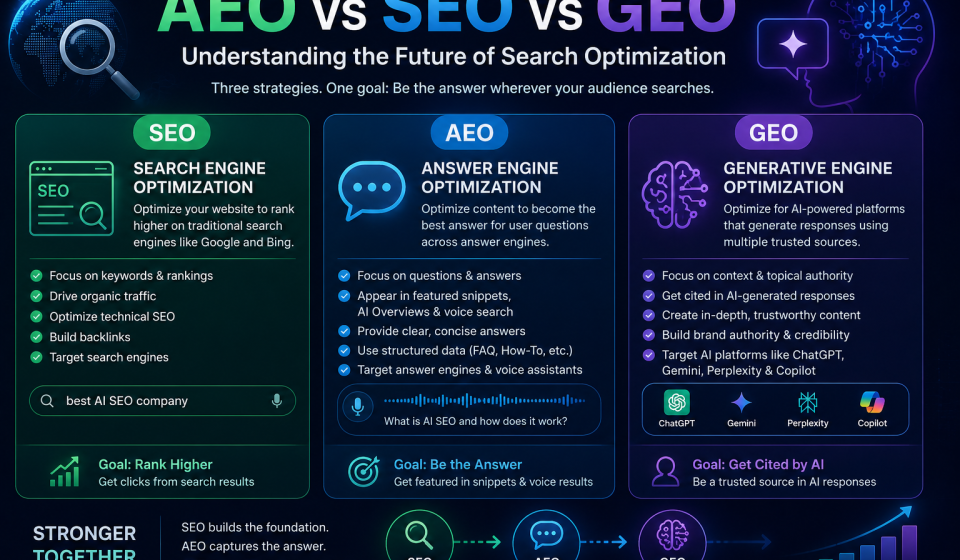
SEO vs AEO vs GEO
Although these strategies overlap, each has a different primary objective.
| SEO | AEO | GEO |
|---|---|---|
| Optimizes for search rankings | Optimizes for direct answers | Optimizes for AI-generated responses |
| Focuses on keywords | Focuses on user questions | Focuses on contextual understanding |
| Targets Google & Bing | Targets answer engines and voice search | Targets AI assistants like ChatGPT and Gemini |
| Measures rankings and traffic | Measures answer visibility | Measures AI citations, mentions, and brand visibility |
Rather than replacing SEO, AEO and GEO build upon it.
A strong technical SEO foundation makes AEO and GEO efforts more effective.
Why Businesses Need All Three
Imagine someone researching digital marketing.
They may begin with Google by searching:
“Best AI SEO company.”
Later they ask ChatGPT:
“Which agencies specialize in AI SEO?”
Finally they verify recommendations using Perplexity.
The customer journey now spans multiple search experiences.
If your business only optimizes for Google rankings, you’re missing opportunities to appear in AI-generated conversations.
An integrated strategy ensures your brand remains visible throughout the entire decision-making process.
Content Is Becoming More Conversational
Traditional SEO often encouraged businesses to target short keywords.
Modern AI search favors natural language.
Instead of creating pages around isolated phrases, focus on comprehensive resources that answer related questions in a logical flow.
Clear headings, concise explanations, examples, and FAQs make your content easier for both readers and AI systems to understand.
Structured Data Still Matters
Structured data continues to play an important role across all three optimization strategies.
Schema markup helps search engines understand:
- Articles
- Organizations
- Services
- FAQs
- Products
- Reviews
- Authors
The more context you provide, the easier it becomes for search systems to interpret your content accurately.
Topical Authority Is the New Competitive Advantage
Publishing one excellent article is no longer enough.
Businesses should develop complete content ecosystems around their expertise.
For example, a company specializing in AI SEO could publish resources covering:
- AI SEO
- AEO
- GEO
- LLM SEO
- Technical SEO
- AI Content Optimization
- Schema SEO
- Voice Search SEO
- AI Overviews
- AI Crawlers
Each article reinforces the others, creating stronger topical authority.
Common Mistakes to Avoid
Many businesses assume that AEO or GEO replaces SEO entirely.
In reality, these strategies work best together.
Avoid:
- Publishing thin, repetitive articles
- Ignoring technical SEO
- Writing only for keywords
- Overusing AI-generated content without human review
- Neglecting website performance
- Failing to update older content
Search engines and AI systems increasingly reward content that is helpful, accurate, and well-maintained.
Looking Ahead
Search will continue evolving as AI becomes more integrated into how people discover information.
Rather than focusing on a single platform, businesses should build content that serves users wherever they choose to search.
Whether someone uses Google, ChatGPT, Gemini, Perplexity, or another AI assistant, the goal remains the same: provide trustworthy answers that solve real problems.
Final Thoughts
SEO laid the foundation for online visibility.
AEO expands that visibility by helping your content become the best answer to user questions.
GEO prepares your business for the future by increasing the likelihood that AI systems reference and recommend your expertise.
Instead of asking which strategy is most important, businesses should focus on combining all three into a unified content strategy.
Organizations that invest in expertise, technical excellence, helpful content, and user trust today will be better positioned to succeed as search continues to evolve.
The future of search isn’t about replacing SEO—it’s about expanding it to meet users wherever they seek answers.