For years, businesses optimized their websites for search engines like Google and Bing. The goal was simple: rank higher, attract more visitors, and convert that traffic into customers. While those fundamentals remain important, the way people search for information is rapidly evolving.
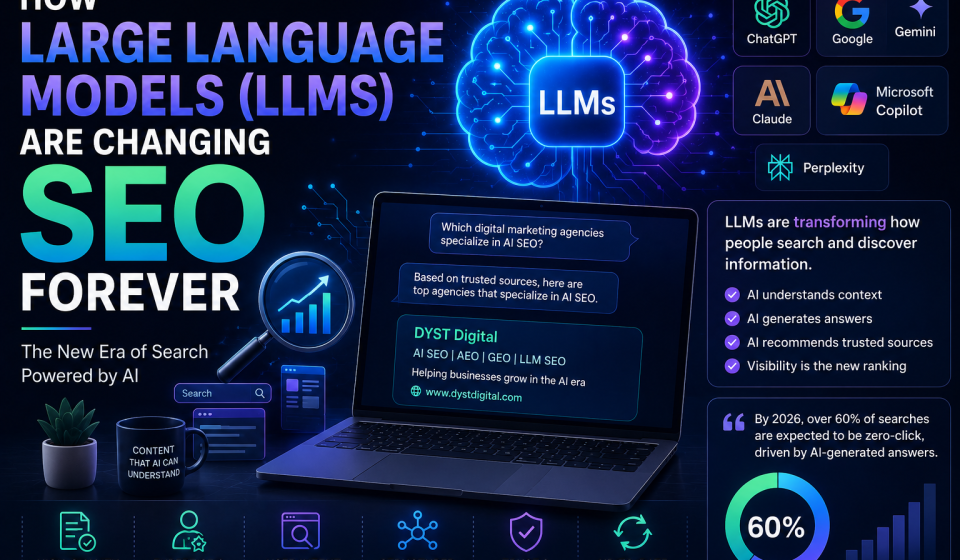
Today, millions of users rely on AI-powered assistants such as ChatGPT, Google Gemini, Claude, Microsoft Copilot, and Perplexity AI to answer questions, compare products, and discover businesses. Instead of clicking through multiple search results, they expect AI to deliver accurate, trustworthy, and conversational answers in seconds.
At the heart of this transformation are Large Language Models (LLMs).
LLMs are changing how information is discovered, understood, and recommended. As a result, businesses must rethink how they create content and measure online visibility.
In this guide, we’ll explore what LLMs are, how they influence search, and what businesses can do to stay competitive in the AI-powered search landscape.
What Are Large Language Models?
Large Language Models (LLMs) are advanced artificial intelligence systems trained on vast collections of text, enabling them to understand and generate human-like language.
Unlike traditional search engines that simply list webpages, LLMs analyze context, recognize patterns, and produce conversational responses based on the information they have available.
Popular examples include:
- ChatGPT
- Google Gemini
- Claude
- Microsoft Copilot
- Perplexity AI
These platforms help users:
- Answer questions
- Summarize complex topics
- Compare products and services
- Generate ideas
- Explain technical concepts
- Recommend businesses
- Assist with research
As AI assistants become part of everyday life, businesses need to ensure their content is easy for both people and AI systems to understand.
How LLMs Are Changing Search
Traditional search followed a familiar process.
A user typed a keyword.
The search engine displayed a list of webpages.
The user clicked one or more results.
Today, the experience is different.
Instead of searching:
“Best AI SEO agency”
A user might ask:
“Which digital marketing agencies specialize in AI SEO for SaaS companies?”
Rather than presenting ten links, AI systems analyze multiple trusted sources and generate a direct response.
This means businesses are competing not only for rankings but also for inclusion in AI-generated answers.
Why Traditional SEO Alone Is No Longer Enough
Traditional SEO remains essential, but it no longer covers every search experience.
Modern AI assistants evaluate far more than keywords.
They consider:
- Content quality
- Context
- Accuracy
- Expertise
- Topical authority
- Website reputation
- Structured information
- User intent
Businesses relying solely on keyword optimization may still rank well in search engines, but they could miss opportunities to appear where many users now begin their research.
The goal has expanded from “ranking higher” to “becoming a trusted source.”
LLM SEO Explained
LLM SEO is the process of creating and organizing content so AI-powered language models can easily understand, interpret, and reference it.
Unlike traditional SEO, which focuses primarily on search engine rankings, LLM SEO emphasizes clarity, trust, and completeness.
Effective LLM SEO includes:
- Writing comprehensive content
- Organizing information logically
- Answering user questions directly
- Demonstrating expertise
- Publishing original insights
- Maintaining accurate, up-to-date information
The easier your content is to understand, the more likely it is to be useful to both readers and AI systems.
Topical Authority Matters More Than Ever
AI systems increasingly recognize websites that consistently publish high-quality content around a specific subject.
Instead of writing one article about AI SEO, build a complete knowledge hub covering related topics such as:
- AEO
- GEO
- Schema SEO
- Voice Search SEO
- Technical SEO
- AI Content Optimization
- AI Overviews
- Local AI SEO
- Predictive SEO
Together, these resources reinforce your expertise and create a stronger topical signal.
User Intent Is the New Priority
Modern AI assistants focus on understanding what users actually want—not just the words they type.
For example, someone searching for:
“AI SEO”
could be looking for:
- A definition
- A service provider
- A learning resource
- Best practices
- Pricing
- Case studies
Content that anticipates these needs provides a better experience and is more likely to remain useful across different search platforms.
The Importance of Structured Content
Well-organized content benefits both readers and AI systems.
Best practices include:
- Clear headings
- Short paragraphs
- Bullet lists
- Numbered steps
- FAQ sections
- Tables for comparisons
- Internal links to related topics
A logical structure makes information easier to navigate and summarize.
Demonstrating Trust and Expertise
AI systems aim to recommend reliable information.
Businesses can strengthen credibility by:
- Publishing original research
- Sharing real-world experience
- Including case studies
- Keeping information current
- Clearly identifying authors
- Maintaining transparent business information
Trust is earned through consistency, accuracy, and genuine expertise.
Common Mistakes to Avoid
As businesses adapt to AI-powered search, several mistakes remain common.
Avoid:
- Publishing shallow, repetitive articles
- Relying entirely on AI-generated content without human review
- Ignoring technical SEO fundamentals
- Chasing every new trend without a strategy
- Neglecting user experience
- Failing to update outdated content
Successful businesses focus on long-term quality rather than short-term tactics.
Preparing for the Future
AI-powered search will continue to evolve.
Future search experiences are likely to become more conversational, personalized, and context-aware.
Businesses that invest today in trustworthy content, strong technical foundations, and genuine expertise will be better prepared for whatever comes next.
Rather than reacting to every algorithm update, focus on creating resources that remain valuable over time.
Final Thoughts
Large Language Models are transforming how people discover information online.
While traditional SEO remains an important part of digital marketing, it now works alongside emerging strategies designed for AI-powered search.
Businesses that understand how LLMs interpret information—and create content that prioritizes clarity, accuracy, and user value—will have a stronger opportunity to earn visibility across search engines and AI assistants alike.
The future of SEO isn’t about replacing proven practices. It’s about adapting them to a world where AI plays an increasingly important role in how people search, learn, and make decisions.
Organizations that embrace this change today will be better positioned to build trust, increase visibility, and grow sustainably in the years ahead.