Search is evolving at a remarkable pace. For years, businesses focused on earning higher rankings in Google’s traditional search results. While that remains important, the introduction of Google AI Overviews has changed how people discover information online.
Instead of displaying only a list of webpages, Google can now generate AI-powered summaries that answer a user’s question directly. These summaries often combine information from multiple trusted sources and present it in a conversational, easy-to-understand format.
For businesses, this represents both an opportunity and a challenge.
The opportunity is greater visibility. If your content is considered reliable, helpful, and authoritative, it may contribute to an AI Overview, exposing your brand to a wider audience.
The challenge is that simply targeting keywords is no longer enough. Your content needs to answer real questions, demonstrate expertise, and provide genuine value.
In this guide, you’ll learn what Google AI Overviews are, how they work, and practical ways to optimize your website for this new era of AI-powered search.
What Are Google AI Overviews?
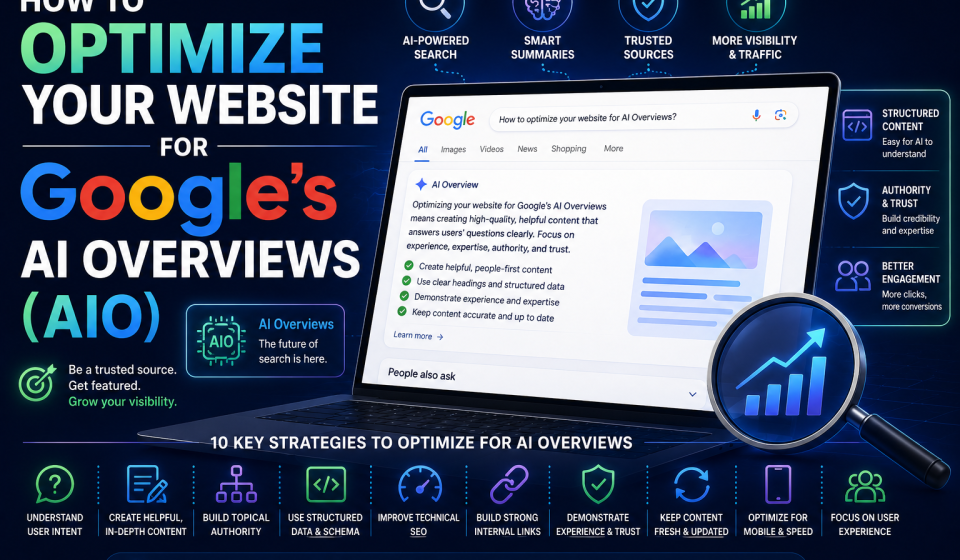
Google AI Overviews are AI-generated summaries that appear at the top of certain search results. Instead of showing only a list of links, Google may present a concise answer that combines information from multiple high-quality sources.
For example, if someone searches:
“How do I optimize my website for AI search?”
Google may display:
- A short AI-generated explanation
- Key recommendations
- Supporting links to authoritative websites
- Additional follow-up questions
The goal is to help users find reliable information more quickly while still providing opportunities to explore the original sources.
Why AI Overviews Matter
AI Overviews are changing how people interact with search.
Many users now receive a helpful summary before deciding whether to visit a website. This means businesses must focus not only on attracting clicks but also on becoming trusted sources of information.
Benefits of appearing in AI-powered search experiences include:
- Increased brand visibility
- Greater authority within your industry
- More qualified website visitors
- Higher trust among potential customers
- Better exposure for educational content
The businesses that consistently publish useful, accurate, and well-structured content are better positioned to benefit from these experiences.
How AI Overviews Differ from Traditional Search
Traditional search typically presents a list of webpages ranked by relevance.
AI Overviews take a different approach by analyzing information from multiple sources and generating a summarized response.
This changes the focus of content creation.
Instead of asking:
“How do I rank for this keyword?”
Ask:
“How can I create the most helpful answer to this question?”
That mindset shift often leads to better content for both users and search engines.
1. Create Content That Answers Real Questions
AI-powered search is designed around user intent.
Think about the questions your audience asks before purchasing a product or service.
Examples include:
- What is AI SEO?
- How do AI Overviews work?
- Is structured data important?
- How can small businesses benefit from AI search?
Answer these questions clearly and early in your content before expanding into more detailed explanations.
2. Build Comprehensive Topic Clusters
One article rarely demonstrates expertise on its own.
Instead, create related content around a central topic.
For example, if your website offers AI SEO services, supporting articles might include:
- AI SEO fundamentals
- AEO (Answer Engine Optimization)
- GEO (Generative Engine Optimization)
- LLM SEO
- Schema Markup
- Voice Search SEO
- Technical SEO
- AI Content Optimization
Link these articles together so readers can easily explore related topics.
3. Improve Content Structure
Well-organized content is easier for readers to navigate and easier for search systems to interpret.
Follow these best practices:
- Use descriptive headings
- Keep paragraphs short
- Include bullet points where appropriate
- Break complex ideas into smaller sections
- Add summaries for long topics
A clear structure improves readability and helps users quickly find the information they need.
4. Demonstrate Experience and Expertise
Google places increasing emphasis on trustworthy content.
Whenever possible, include:
- Original insights
- Real-world examples
- Case studies
- Practical recommendations
- Lessons learned from actual projects
Unique experience adds value that generic content cannot easily replicate.
5. Keep Your Content Up to Date
AI search systems benefit from current, accurate information.
Review important pages regularly to:
- Update statistics
- Refresh screenshots
- Improve explanations
- Add recent examples
- Remove outdated advice
Regular updates show that your website remains an active and reliable resource.
6. Strengthen Your Technical SEO
Technical SEO continues to support discoverability.
Make sure your website:
- Loads quickly
- Works well on mobile devices
- Uses HTTPS
- Has descriptive page titles
- Includes clear URLs
- Avoids broken links
- Is easy to crawl
A technically healthy website provides a better experience for both users and search engines.
7. Use Structured Data Where Appropriate
Structured data helps search engines understand the context of your pages.
Depending on your content, consider implementing schema for:
- Articles
- Organizations
- FAQs
- Services
- Reviews
- Breadcrumbs
While structured data doesn’t guarantee inclusion in AI Overviews, it can improve how your content is interpreted.
8. Write Naturally
Avoid writing solely for search engines.
Instead:
- Use conversational language.
- Explain complex ideas simply.
- Define technical terms.
- Avoid unnecessary repetition.
Content that sounds natural is more enjoyable to read and often aligns better with conversational search queries.
9. Strengthen Internal Linking
Every important article should guide readers to related resources.
For example, an article about AI Overviews could naturally link to:
- AI SEO
- Technical SEO
- Schema SEO
- AEO
- LLM SEO
- AI Content Optimization
Internal links improve navigation and help visitors continue learning.
10. Focus on User Experience
Great content deserves a great user experience.
Consider:
- Fast loading times
- Clear navigation
- Readable typography
- Accessible design
- Minimal distractions
A positive experience encourages visitors to stay longer and explore additional pages.
Common Mistakes to Avoid
Many websites struggle because they:
- Publish thin or repetitive content
- Overuse keywords unnaturally
- Ignore technical SEO
- Rely entirely on AI-generated text without careful editing
- Neglect content updates
- Forget to write for real people
Prioritize quality, accuracy, and usefulness over shortcuts.
Measuring Success
Success isn’t defined by a single metric.
Track indicators such as:
- Organic traffic
- Engagement time
- Conversion rate
- Qualified leads
- Returning visitors
- Brand awareness
- Performance of key content pages
These measurements provide a broader picture of how your content is supporting your business goals.
Frequently Asked Questions
Do AI Overviews replace traditional search results?
No. AI Overviews complement traditional search results by providing summarized information while still linking users to relevant websites.
Can any website appear in AI Overviews?
There is no guaranteed way to appear. However, publishing accurate, helpful, and well-structured content increases the likelihood that your information is considered valuable.
Is technical SEO still important?
Yes. Fast performance, mobile usability, crawlability, and clear site architecture continue to support search visibility.
Should I stop focusing on traditional SEO?
No. Traditional SEO remains a critical foundation. Optimizing for AI-powered search should build on—not replace—strong SEO fundamentals.
Final Thoughts
Google AI Overviews represent another step in the evolution of search. Rather than changing the goal of SEO, they reinforce an important principle: create content that genuinely helps people.
Businesses that combine technical excellence with original expertise, thoughtful content, and a great user experience will be well positioned for the future of search.
Instead of chasing algorithms, focus on becoming a trusted source within your industry. When your website consistently answers real questions with clarity and accuracy, you’re building a resource that benefits readers today and remains valuable as AI-powered search continues to evolve.