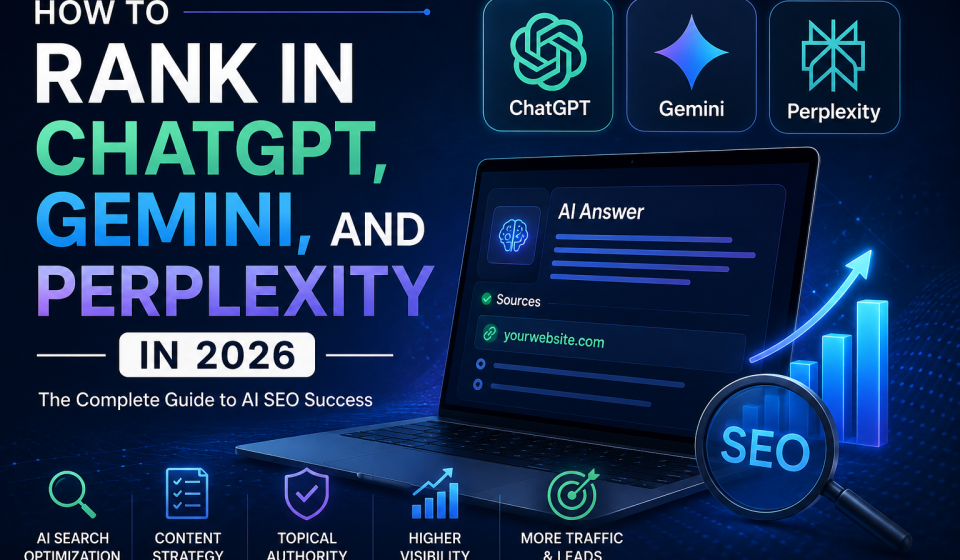
The Complete Guide to AI SEO: How to Rank in ChatGPT, Gemini, and Perplexity in 2026
Search is changing faster than ever.
For years, businesses focused on ranking on Google’s first page. Today, that’s still important—but it’s no longer the whole picture. Millions of people now ask questions directly to AI-powered platforms like ChatGPT, Google Gemini, Perplexity AI, Microsoft Copilot, and Claude. Instead of scrolling through ten blue links, users expect a single, accurate, conversational answer.
This shift has created a new challenge for businesses: How do you make sure your website becomes part of those AI-generated answers?
The answer lies in AI SEO.
AI SEO is the next evolution of search engine optimization. It combines traditional SEO best practices with strategies designed to help AI systems understand, trust, and reference your content. Rather than focusing only on rankings, AI SEO aims to improve your visibility across search engines, AI assistants, answer engines, and large language models.
Whether you’re a local business, an eCommerce brand, a SaaS company, or a global enterprise, understanding AI SEO in 2026 isn’t optional—it’s becoming essential.
In this guide, we’ll explain what AI SEO is, how platforms like ChatGPT, Gemini, and Perplexity discover information, and the strategies you can use to improve your visibility in the AI-powered search landscape.
What Is AI SEO?
AI SEO is the practice of optimizing your website so that both traditional search engines and AI-powered search platforms can understand, trust, and recommend your content.
Unlike traditional SEO, where success is measured by keyword rankings and organic traffic, AI SEO focuses on becoming a reliable source of information that AI systems are confident enough to cite or summarize.
Think of it this way:
Traditional SEO asks:
“How do I rank #1 on Google?”
AI SEO asks:
“How do I become the best answer wherever users are searching?”
That includes platforms such as:
- ChatGPT
- Google Gemini
- Perplexity AI
- Microsoft Copilot
- Claude
- AI Overviews in Google Search
- Voice assistants
- Future AI-powered search engines
These systems don’t simply look for keywords. They evaluate context, credibility, authority, structured data, topical expertise, and user value before generating responses.
Why AI SEO Matters in 2026
The way people search online has changed dramatically.
Instead of typing:
“best SEO agency”
Users now ask:
- Which SEO agency specializes in AI search?
- Who offers AI SEO services for SaaS companies?
- What’s the best strategy for ranking in ChatGPT?
- How can I improve my website’s visibility in AI search engines?
These questions are longer, more conversational, and often require detailed answers.
AI assistants process these queries differently than traditional search engines. Rather than matching keywords alone, they analyze meaning, context, intent, and authority.
Businesses that continue relying solely on traditional SEO may still receive traffic from Google Search, but they risk becoming invisible where many users are beginning their online journeys.
As AI-powered search continues to grow, optimizing for these platforms can help businesses:
- Reach users earlier in the buying journey
- Increase brand visibility
- Build trust through authoritative content
- Generate qualified leads
- Future-proof their digital marketing strategy
How ChatGPT, Gemini, and Perplexity Find Information
One common misconception is that AI models simply “know everything.”
In reality, modern AI search systems rely on several sources when generating responses.
1. Search Engine Indexes
Platforms like Google Gemini work closely with Google’s search ecosystem. If your website is well-optimized and indexed, it has a better chance of appearing in AI-generated answers.
Strong technical SEO, crawlability, and high-quality content remain essential.
2. Trusted Websites
AI systems tend to reference websites that consistently publish accurate, comprehensive, and reliable information.
They evaluate factors such as:
- Content quality
- Expertise
- Authority
- Freshness
- Reputation
- User experience
This is why investing in well-researched, original content often delivers long-term results.
3. Structured Data
Schema markup helps search engines and AI systems understand your content more effectively.
It provides additional context about:
- Articles
- Services
- Organizations
- FAQs
- Products
- Reviews
- Authors
The clearer your website communicates its information, the easier it becomes for AI systems to interpret it correctly.
4. Topical Authority
Publishing one excellent article isn’t enough anymore.
AI models prefer websites that demonstrate deep expertise across an entire subject.
For example, instead of writing only one article about AI SEO, a strong website might also publish content covering:
- AEO (Answer Engine Optimization)
- GEO (Generative Engine Optimization)
- LLM SEO
- AI Content Optimization
- Schema Markup
- Voice Search
- AI Overviews
- Technical SEO
- AI Crawlers
- Prompt Optimization
Together, these pages create a network of related content that signals expertise.
How AI Search Differs From Traditional Search
Although traditional SEO remains important, AI-powered search introduces several key differences.
Traditional Search
Users enter keywords.
Search engines return a list of websites.
The user decides which result to click.
Success depends largely on rankings and click-through rates.
AI Search
Users ask complete questions.
AI analyzes multiple trusted sources.
It generates a direct answer.
Sometimes users never visit a website unless it is cited or recommended.
This means visibility now extends beyond rankings.
Your goal isn’t just to appear on Page 1—it is to become a trusted source that AI systems confidently reference.
The Rise of Conversational Search
People naturally communicate through conversations, not isolated keywords.
Instead of searching:
“technical SEO”
They now ask:
“What technical SEO improvements should I make before launching a new website?”
Or:
“How do I optimize my website for ChatGPT and Google Gemini?”
AI search thrives on conversational language.
That’s why modern content should answer complete questions instead of focusing only on keyword density.
Well-structured headings, concise explanations, and naturally written content make it easier for AI systems to understand and summarize your pages.
EEAT Has Become More Important Than Ever
Google’s concept of Experience, Expertise, Authoritativeness, and Trustworthiness (EEAT) is becoming increasingly relevant in AI SEO.
AI platforms are more likely to surface information from sources that demonstrate genuine expertise.
You can strengthen EEAT by:
- Publishing original insights instead of rewriting existing articles
- Showing real-world experience through case studies
- Including author information
- Citing reputable sources where appropriate
- Keeping content up to date
- Maintaining a secure, fast, and user-friendly website
When users trust your content, search engines and AI systems are more likely to trust it as well.
Quality Always Wins Over Quantity
Publishing hundreds of short articles is no longer an effective long-term strategy.
One comprehensive, well-researched guide that thoroughly answers a user’s question often outperforms multiple thin pages.
Ask yourself:
- Does this article genuinely solve a problem?
- Is the information accurate and current?
- Would someone bookmark or share it?
- Does it provide unique value?
If the answer is yes, you’re creating the type of content AI search platforms increasingly prefer.
AI SEO is not about chasing algorithms. It’s about creating content that deserves to be discovered, understood, and recommended. As AI becomes a bigger part of how people search for information, businesses that focus on expertise, helpfulness, and user experience will be in the strongest position to earn visibility across both traditional search engines and AI-powered platforms.